
Akwarystyka morska JadwigaMorska.pl


 Exists
(889 szt.)
Exists
(889 szt.)
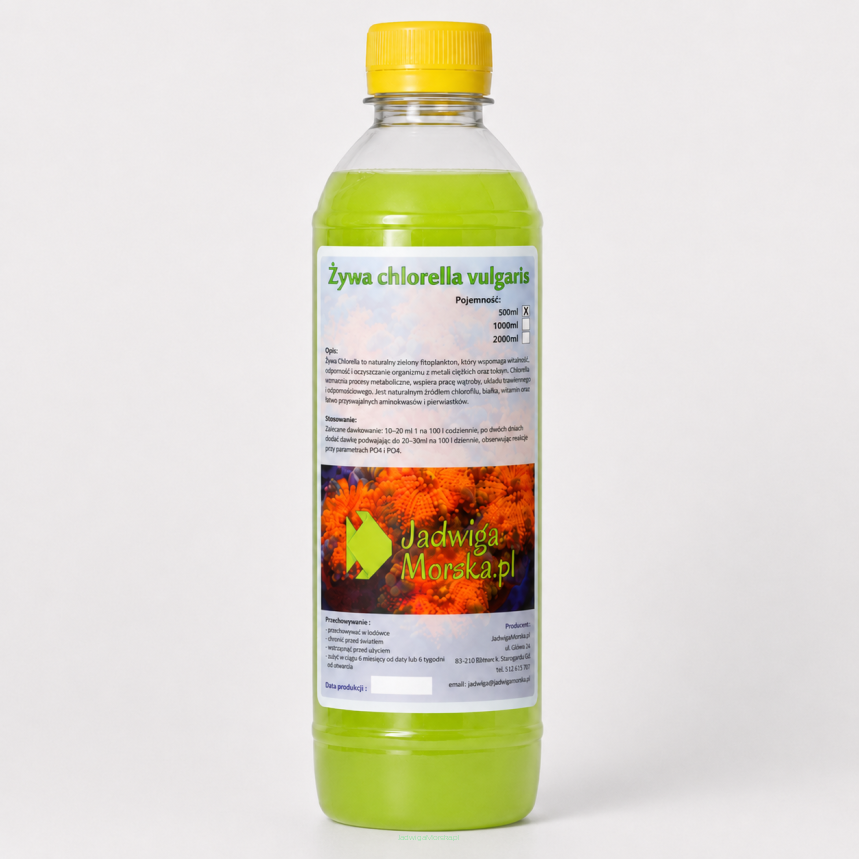
Live Chlorella is a natural green phytoplankton that supports the development of microfauna, feeds filter feeders, improves the biological diversity of the aquarium and helps create a stable food chain in a marine tank.
The best results are achieved with regular dosing and when used together with other marine phytoplankton species such as Nannochloropsis, Tetraselmis and Isochrysis.
Live Chlorella in a marine aquarium can be a very useful addition, but it is best treated as part of a phytoplankton mix rather than as the only food source.
Live Chlorella is a small single-celled alga that can be used by organisms such as rotifers, copepods, small zooplankton, larvae and some filter feeders. FAO reports that Chlorella has been one of the most commonly used algae for culturing the rotifer Brachionus plicatilis, a classic live food in aquaculture.
Most corals do not “eat” large amounts of Chlorella itself as effectively as they consume zooplankton, but Chlorella helps increase the amount of small life in the aquarium. In other words, Chlorella first feeds the microfauna, and the microfauna later becomes a natural food source for LPS, SPS, soft corals and filter feeders.
Live phytoplankton may compete with unwanted microorganisms for nutrients. When dosed regularly and sensibly, it helps build a more stable food chain:
phytoplankton → zooplankton → corals/fish
Live Chlorella consumes nitrates and phosphates during growth. It should not be treated as the main method for reducing NO3/PO4, but rather as biological support. The effect depends on whether the cells actually remain alive, are consumed, or are removed by the skimmer/filtration.
Chlorella vulgaris contains a high amount of protein — often reported at around 42–58% of dry weight — as well as amino acids, pigments and bioactive compounds. In the aquarium, this means a valuable “green” food for small life.
Chlorella is good, but it is not an ideal standalone marine phytoplankton because it usually contains little or none of the key marine fatty acids EPA and DHA. Studies on the fatty acid profile of Chlorella indicate that it is usually not rich in EPA/DHA, although it may contain ALA.
That is why, in a marine aquarium, it works best as part of a mix, for example:
Chlorella + Nannochloropsis + Tetraselmis + Isochrysis
This gives a better nutritional profile: protein, pigments, green phytoplankton, a fine food fraction and better fats for zooplankton.
Live Chlorella is especially useful in aquariums with:
Do not dose too much at once. Too high a dose may cause cloudy water, bacterial film growth, dirtier glass, lower oxygen levels at night or increased load on the protein skimmer.
With live phytoplankton, small but regular doses usually work best.
At the beginning:
10–20 ml per 100 litres daily
After 1–2 weeks, the dose may be increased to:
30–50 ml per 100 litres daily
In heavily stocked aquariums with many filter feeders and rich microfauna, higher doses may be used, but water clarity, glass film, NO3, PO4 and coral response should be monitored carefully.
Shelf life when refrigerated: 8 weeks.